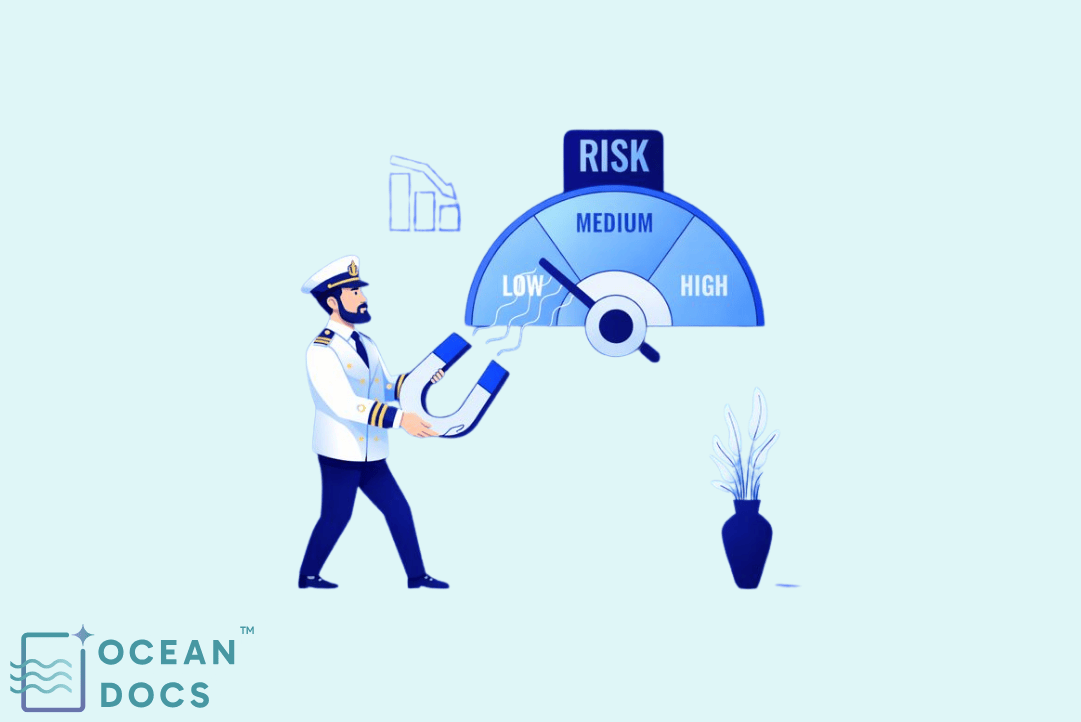
AI for Real-Time Risk Assessment in Fleet Documentation
December 16, 2025 By OceanDocs AI
What if fleet managers could spot compliance risks the moment they appear in shipping documents? In today’s maritime industry, risks rarely come from a single missing file. They build up quietly across outdated certificates, incomplete records, and delayed updates. This is where AI for real-time risk assessment in fleet documentation is changing how shipping teams work.
Modern fleets handle thousands of shipping documents every day. These include certificates, manuals, reports, and logs that support safe and compliant operations. Manual checks struggle to keep pace with this volume. AI brings speed, consistency, and clarity to maritime documentation by identifying risks as soon as they surface.
Why fleet documentation risk is hard to manage
Fleet documentation risk often hides in plain sight. A document may exist but remain outdated. A report may look complete but miss a critical reference. When teams rely on manual reviews, these issues can go unnoticed until an inspection or incident.
Maritime operations also involve frequent updates. Regulations change, formats evolve, and reporting requirements expand. Without continuous monitoring, shipping documentation quickly loses accuracy. This creates gaps that affect maritime compliance and operational confidence.
AI helps address this challenge by reviewing documents continuously instead of periodically. It turns static records into living data sources that reflect real operational risk.
What real-time risk assessment means in practice
Real-time risk assessment means the system reviews fleet documents as they are uploaded, updated, or referenced. Instead of waiting for audits or inspections, risks appear immediately on dashboards or alerts.
AI models scan maritime documentation for missing sections, outdated references, and mismatches between documents. For example, if a safety procedure does not align with the latest operational manual, the system flags the issue. This allows teams to act before the risk escalates.
AI in maritime environments focuses on early detection. It does not replace human judgment. It supports it by reducing blind spots and repetitive checks.
Role of AI document intelligence in fleets
AI document intelligence sits at the core of this shift. It reads and understands unstructured shipping documents such as PDFs, scans, and reports. It identifies patterns, key terms, and compliance signals across large document sets.
In fleet management, this intelligence helps map documents to specific vessels, operations, and risk categories. When something changes, the AI recalculates risk levels automatically. This creates a clear view of which vessels carry higher documentation risk at any moment.
AI document intelligence also improves traceability. Teams can see why a document was flagged and which sections caused concern. This transparency builds trust in the system.
How maritime AI improves decision making
Maritime AI transforms documentation into actionable insight. Instead of reacting to inspection outcomes, teams can prioritize work based on real-time risk signals.
For example, a fleet manager can focus attention on vessels with higher documentation risk while allowing compliant vessels to operate without interruption. This targeted approach improves efficiency and reduces unnecessary workload.
AI-powered maritime operations solutions also support better communication across teams. Risk insights become shared knowledge rather than siloed information. This alignment strengthens fleet-wide awareness.
Reducing compliance pressure with AI
Shipping compliance often feels reactive. Teams rush to prepare documents before inspections or reviews. AI changes this rhythm by keeping documentation ready at all times.
Maritime compliance software powered by AI checks consistency across documents and highlights deviations early. This reduces last-minute stress and supports steady compliance management.
By maintaining a clear compliance posture, fleets improve confidence during inspections and audits. Risk discussions shift from damage control to continuous improvement.
Supporting fleet and ship management teams
Fleet management solutions increasingly rely on AI to support daily operations. Documentation risk connects directly to operational risk. When records stay accurate, teams operate with better clarity.
Ship management software enhanced with maritime AI allows managers to track documentation health alongside operational data. This integrated view supports smarter planning and faster response.
AI in shipping also reduces manual workload. Teams spend less time searching for issues and more time resolving them. This improves productivity without increasing headcount.
Building trust through consistent monitoring
Consistency remains one of the biggest benefits of AI-based risk assessment. Human reviews vary based on experience and workload. AI applies the same rules every time.
This consistency builds trust across the organization. Teams know that documentation checks follow defined logic and standards. Over time, this leads to stronger documentation habits and fewer surprises.
Maritime AI also creates a feedback loop. As teams correct issues, the system learns from updated patterns and improves future assessments.
The future of fleet documentation risk management
As fleets grow more digital, documentation will continue to expand in volume and complexity. AI-powered maritime operations solutions offer a scalable way to manage this growth.
Real-time risk assessment will move from being a competitive advantage to a basic requirement. Fleets that adopt AI early gain better control, faster insights, and stronger compliance confidence.
In the long run, AI will help maritime teams shift focus from document handling to operational excellence.
Conclusion
AI for real-time risk assessment in fleet documentation brings clarity to one of the most complex areas of maritime operations. By using AI document intelligence and maritime AI, fleets can identify risks early, maintain compliance, and support smarter decision making. OceanDocs AI helps shipping teams turn documentation into a reliable foundation for safe and compliant operations.