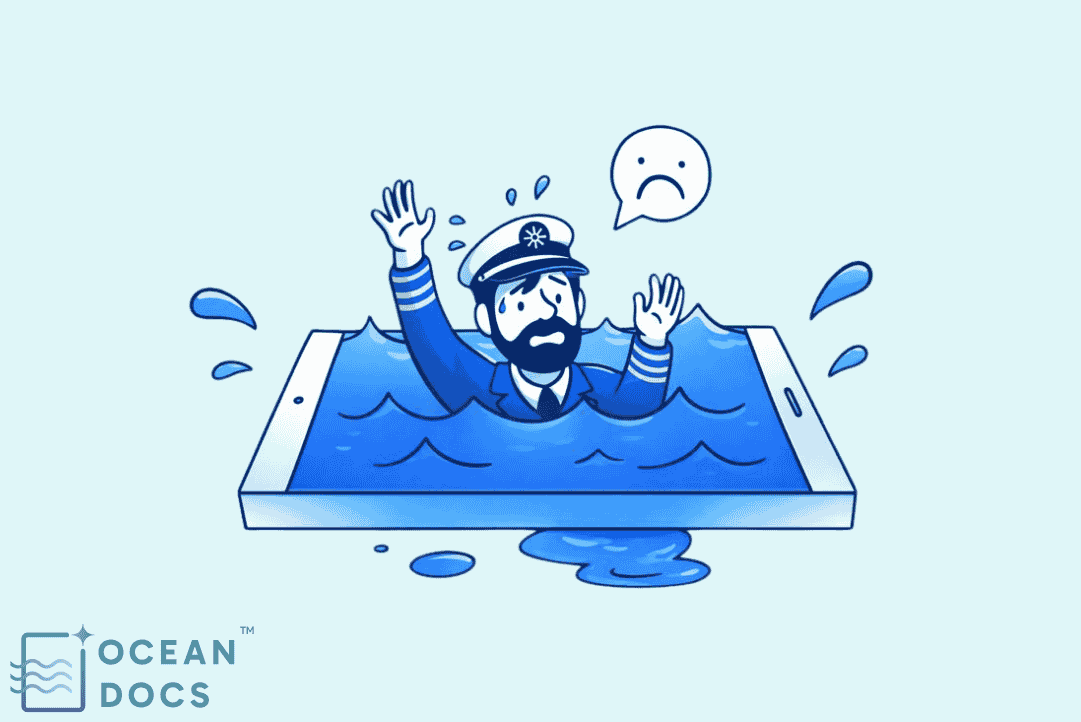
How Cognitive Overload Impacts Safety at Sea
January 12, 2026 By OceanDocs AI
Have you ever wondered why experienced crews still miss critical details during incidents at sea?
The answer often lies in cognitive overload. Life onboard a vessel demands constant attention. Crews manage navigation safety, marine operations, inspections, and reporting, all while staying compliant with maritime regulations. When too much information competes for attention, even small details can slip through.
Cognitive overload is not about skill gaps. It is about how information reaches people under pressure.
What cognitive overload looks like onboard
At sea, decisions rarely happen in calm conditions. Crews work under time pressure, environmental risks, and operational constraints. During these moments, the brain prioritizes immediate actions over information recall.
Shipping documents and maritime documentation may be available, but accessing them takes time. Crews rely on memory, shortcuts, or assumptions instead of searching ship documents. This increases the risk of missing key steps related to vessel safety and shipping compliance.
Why more documents do not mean better safety
Modern vessels carry extensive shipping documentation. Fire Control Plan records, procedures linked to SOLAS, MARPOL, and the ISM Code, and instructions for navigation safety often exist in detail.
The challenge is volume and fragmentation. Documents spread across folders, formats, and systems create mental strain. Crews must remember where information lives before they can even use it.
When cognitive load increases, safety decreases.
How overload affects decision-making
Under overload, people simplify decisions. They skip checks, delay verification, or rely on past experience.
In maritime operations, this can affect responses during emergencies, inspections, or audits. A missed update in ship documents can impact compliance with IMO regulations or lead to findings during Port State Control checks.
Cognitive overload turns manageable tasks into risks.
Compliance pressure adds to mental strain
Maritime compliance demands accuracy and consistency. Crews must follow procedures tied to SOLAS, MARPOL, STCW, ISPS Code, and other frameworks.
Tracking compliance manually increases workload. Each checklist, report, and approval adds to mental pressure. Over time, compliance tasks feel separate from operations, even though they are deeply connected.
This separation makes errors more likely during high-pressure situations.
The role of AI in reducing cognitive overload
AI in maritime focuses on reducing mental effort, not replacing human judgment.
AI document intelligence reads and understands shipping documents. It links maritime documentation to real operational contexts. Instead of crews searching for information, the system brings relevant content forward.
This approach supports faster and safer decisions during marine operations.
Turning information into timely guidance
Traditional documentation explains what to do. Maritime AI helps crews see what matters now.
During inspections, AI can highlight required shipping documentation. During incidents, it can surface safety-related information like procedures or plans. This reduces search time and cognitive strain.
AI in shipping shifts information access from manual search to contextual awareness.
Supporting safety without adding complexity
Adding tools does not always solve overload. Too many systems increase confusion.
AI-powered maritime operations solutions work best when they integrate quietly into existing workflows. Crews receive guidance when needed without navigating complex interfaces.
This helps ship management and fleet management teams maintain safety standards without increasing workload.
Why cognitive overload impacts audits and inspections
Audit readiness depends on timely access to accurate information. Under pressure, missing documents or outdated records create compliance risks.
Maritime AI supports audit readiness by organizing and surfacing documentation proactively. This reduces last-minute stress and improves confidence during inspections.
When information flows smoothly, crews stay focused on operations instead of paperwork.
Long-term impact on vessel safety
Cognitive overload does not cause a single failure. It creates small gaps over time.
Missed updates, delayed checks, and overlooked procedures slowly weaken safety systems. Over months, these gaps affect vessel safety, operational efficiency, and compliance posture.
Reducing overload strengthens safety culture across marine operations.
Conclusion
Cognitive overload is a hidden risk at sea. It affects how crews process information, make decisions, and maintain safety under pressure.
By using AI document intelligence and maritime AI, shipping teams can reduce mental strain and improve access to critical information. This supports safer decisions, stronger compliance, and more confident crews.
OceanDocs AI helps maritime teams reduce cognitive overload by turning shipping documentation into clear, timely operational guidance without adding complexity.
FAQs
What causes cognitive overload at sea?
High workloads, fragmented information, and time pressure during marine operations contribute to overload.
Does more documentation improve safety?
Not always. Without easy access, more documents can increase mental strain.
How does AI help reduce cognitive overload?
AI document intelligence surfaces relevant information at the right time, reducing search effort.
Is maritime AI difficult for crews to use?
No. When designed well, AI-powered maritime operations solutions work quietly within existing workflows.