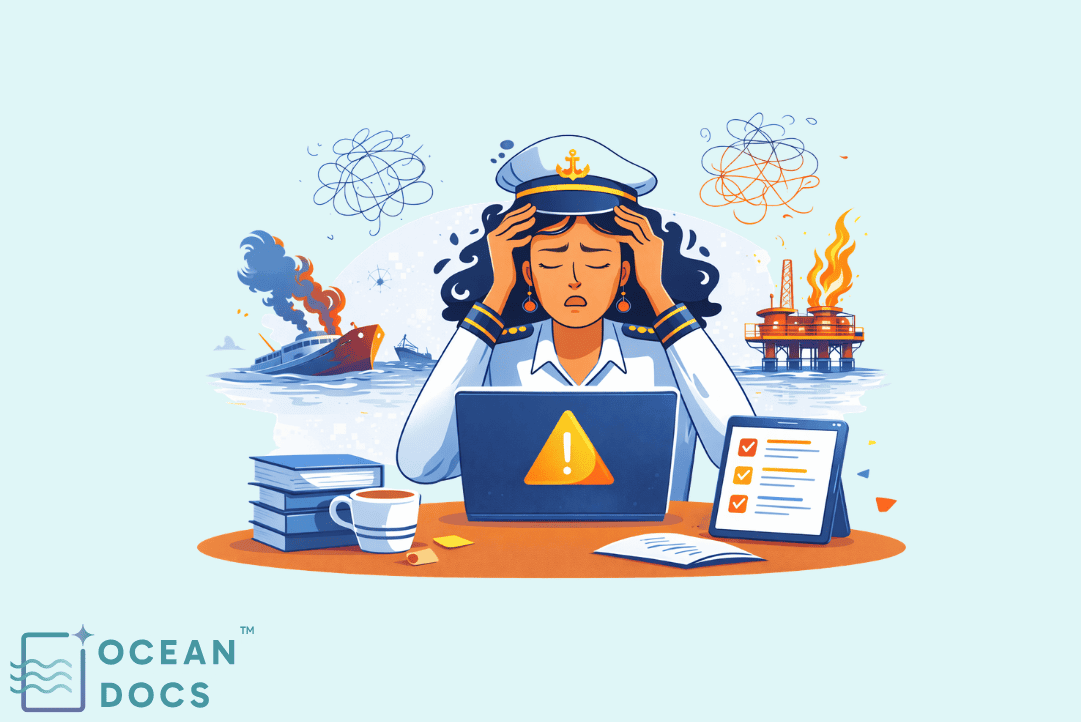
Why Critical Knowledge Isn’t Written Down
March 17, 2026 By OceanDocs AI
Why is some of the most important knowledge on a ship never written down?
In maritime operations, experience often lives in people, not in systems. Crew members learn through years of practice, inspections, and real incidents. This knowledge helps maintain vessel safety, support shipping compliance, and meet maritime regulations.
Yet much of this knowledge never becomes part of shipping documents or maritime documentation. When crew change, this knowledge often disappears. This creates risks in marine operations, audit readiness, and compliance with IMO regulations.
The Nature of Maritime Knowledge
Maritime work is complex and practical. Crew members deal with real situations that are not always covered in ship documents.
Procedures like the Fire Control Plan, navigation safety, and pollution prevention are documented. However, the way they are applied often depends on experience.
For example, handling a Port State Control inspection or a sire inspection requires more than written rules. It needs understanding built over time.
This is why much of the knowledge remains unwritten and informal.
Why Critical Knowledge Isn’t Written Down
Experience Is Hard to Capture
Many tasks depend on judgment.
Crew members learn how to interpret maritime regulations like SOLAS, MARPOL, and the ISM Code in real conditions.
This knowledge is difficult to convert into structured shipping documentation.
Example: A chief engineer may know how to handle equipment issues based on past failures. This insight rarely becomes part of maritime documentation.
Time Constraints at Sea
Life onboard is busy.
Crew members focus on operations, maintenance, and compliance tasks.
There is limited time to document lessons or update ship documents.
Tasks like ship surveys, marine surveying, and ISM compliance take priority.
Dependence on Informal Communication
Knowledge is often shared through conversations.
Senior crew guide junior crew during operations.
This creates strong learning but weak documentation.
When crew leave, the knowledge leaves with them.
Complex and Changing Regulations
Maritime regulations change frequently.
Rules under IMO regulations, ISPS Code, STCW, and ISGOTT require constant updates.
Maintaining accurate shipping documents becomes challenging.
This leads to gaps in documentation.
Lack of Structured Systems
Many vessels still rely on basic documentation systems.
Ship management software may store ship documents, but it does not capture insights or experiences.
Without smart documentation tools, knowledge remains scattered.
Risks of Unwritten Knowledge
Loss of Expertise
When experienced crew leave, their knowledge is lost.
This affects ship crew management and overall efficiency.
Compliance Gaps
Incomplete maritime documentation can lead to issues during Port State Control or sire vetting.
Missing knowledge can result in non-compliance with maritime compliance standards.
Safety Risks
Unwritten procedures can impact vessel safety.
Critical tasks related to COLREGs, Ballast Water Management, and LSA Code require clear understanding.
Operational Inefficiencies
Without proper documentation, teams repeat mistakes.
This affects fleet management and marine operations.
Role of AI in Capturing Maritime Knowledge
AI Document Intelligence
AI document intelligence helps convert unstructured knowledge into structured formats.
It captures insights from reports, logs, and ship documents.
This improves maritime compliance and audit readiness.
Smart Documentation Systems
Smart documentation tools organize shipping documentation and make it accessible.
They ensure that knowledge is stored and shared across teams.
AI in Shipping Operations
AI in shipping supports decision making and knowledge sharing.
It helps analyze data from ship surveys, inspections, and operations.
This improves efficiency and safety.
Maritime Compliance Software
Maritime compliance software ensures that ship documents align with maritime regulations.
It helps maintain ISM compliance and supports inspections.
Practical Example
A tanker ship faced repeated issues during sire inspection.
The crew relied on experience to handle inspections, but this knowledge was not documented.
After implementing AI-powered maritime operations solutions, the company used AI document intelligence to capture insights from past inspections.
It created structured shipping documentation and improved audit readiness.
As a result, inspection performance improved, and compliance risks reduced.
How to Capture Critical Knowledge
Standardize Documentation
Use consistent formats for shipping documents.
This helps in organizing information and improving accessibility.
Use AI Tools
Leverage AI in maritime to capture and analyze data.
AI-powered systems can identify patterns and store insights.
Encourage Knowledge Sharing
Promote a culture where crew members document their experiences.
This strengthens maritime documentation.
Integrate Systems
Use advanced ship management software and fleet management solutions.
This ensures that all data is stored in one place.
Regular Updates
Keep ship documents updated with the latest insights and regulations.
This supports compliance with IMO regulations.
Benefits of Capturing Knowledge
Improved Compliance
Better documentation ensures compliance with maritime regulations and standards.
Enhanced Safety
Clear procedures improve vessel safety and navigation safety.
Better Operational Efficiency
Teams work more effectively with access to accurate information.
Stronger Audit Readiness
Structured documentation supports inspections and audits.
Conclusion
Critical knowledge in maritime operations often remains unwritten due to time constraints, complexity, and reliance on experience. This creates risks in compliance, safety, and efficiency.
By using AI in shipping, AI document intelligence, and smart documentation systems, organizations can capture and manage this knowledge effectively.
Modern maritime compliance software and AI-powered maritime operations solutions help transform informal knowledge into structured insights.
OceanDocs AI enables companies to build strong maritime documentation systems, improve compliance, and ensure that critical knowledge is never lost.
FAQs
-
Why is maritime knowledge often not documented?
It is based on experience, informal sharing, and time constraints. -
How does AI in maritime help capture knowledge?
AI analyzes data and converts it into structured documentation. -
What is AI document intelligence?
It is the use of AI to extract and organize information from documents. -
Why is maritime compliance important?
It ensures safety, regulatory adherence, and smooth operations. -
How can companies improve shipping documentation?
By using smart documentation tools, AI systems, and standardized processes.