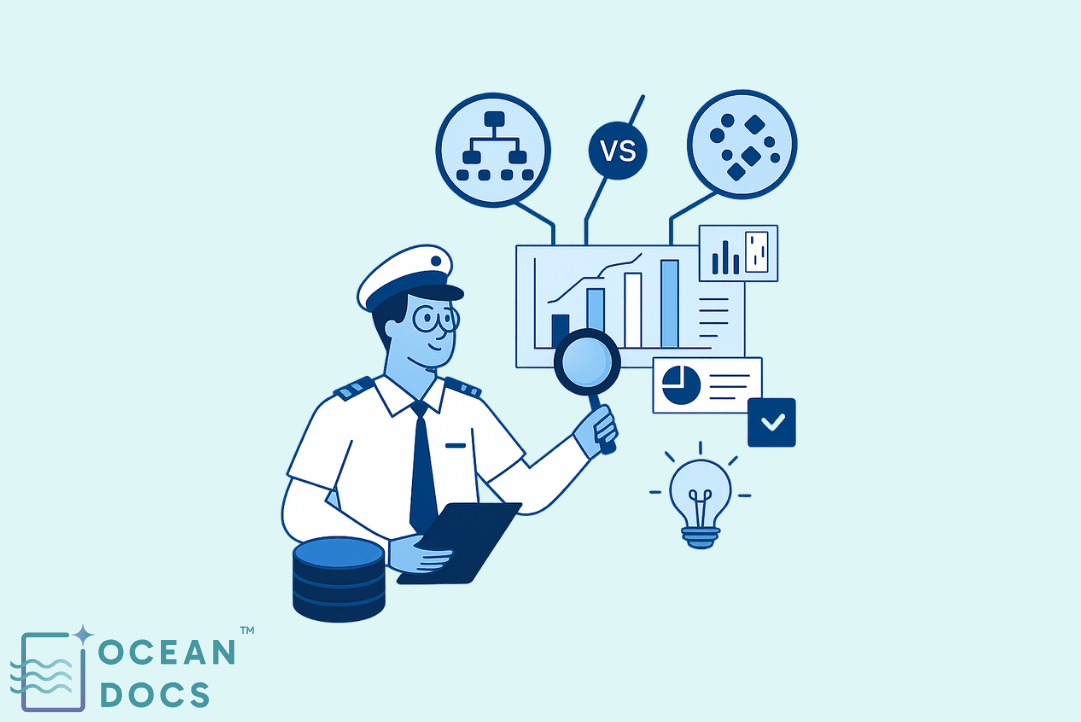
Structured vs Unstructured Docs: How AI Handles Both at Sea
December 3, 2025 By OceanDocs AI
Maritime paperwork never slows down. Every voyage creates a steady flow of reports, checklists, certificates, emails, and handwritten notes. In order to make quicker decisions, improve maritime compliance, and create safer vessels, shipping companies must now understand how AI handles both structured and unstructured documents at sea.
What structured and unstructured documents mean on board
Structured documents follow a clear format. They use fixed fields and layouts, like cargo manifests, crew lists, bunker delivery notes, and forms inside shipping documentation. These records fit easily into databases and maritime compliance software.
Unstructured documents are different. They include free-text emails, handwritten notes, scanned shipping documents, technical manuals, and long PDF circulars. Many maritime regulations sit inside these files, which makes searching difficult. When systems cannot process this information well, vessel safety checks and HSEQ actions slow down.
Everyday examples on a modern vessel
On a tanker, structured data includes SIRE vetting checklists, ISM Code forms, maintenance logs, and PSC inspection records. These support ISM compliance, crew planning, and general reporting.
Unstructured data includes bridge notes, scanned certificates linked to SOLAS maritime rules, MARPOL regulations, and emails about cargo or equipment. Answers to simple questions like what is SOLAS, what is MARPOL, or SOLAS definition are often buried inside long documents. Without strong document intelligence, crews spend time searching instead of taking action.
Why this difference matters for maritime compliance
Compliance teams must show that vessel operations follow SOLAS, MARPOL, the ISPS Code, and the International Safety Management framework. Each regulation produces its own set of ship documents. Structured evidence sits inside checklists and forms. Unstructured evidence appears in incident descriptions, HSEQ reports, and risk assessments.
During vetting inspection preparation, inspectors review both. They check structured entries inside maintenance systems and then read narrative reports to understand safety culture. The same approach applies to SIRE inspection and the updated SIRE 2.0 model, which expects consistent information across all types of maritime documentation.
How AI reads structured documents at sea
AI in maritime identifies fields, tables, and standard layouts with high accuracy. A form linked to HSEQ can be captured directly and converted into searchable data for maritime compliance software.
AI document intelligence can:
-
Extract fields from cargo checklists and bunker forms
-
Match entries with MARPOL regulations and specific annexes
-
Confirm required fields before a voyage or port call
-
Highlight missing entries that may create PSC inspection risks
This reduces manual work and ensures that references such as MARPOL stands for what or SOLAS meaning remain linked to the correct regulatory source.
How AI unlocks unstructured maritime documents
The biggest value comes from processing unstructured content. AI can read long PDFs, emails, and scanned certificates, then extract the details needed for maritime regulations and vessel safety decisions.
Modern maritime AI can:
-
Digitize certificates linked to IMO MARPOL and SOLAS maritime rules
-
Detect references to international safety management or what is ISM Code inside documents
-
Summarize long incident reports for HSEQ dashboards
-
Spot patterns or recurring defects that may affect SIRE vetting results
This turns old archives of shipping documentation into clean, searchable information that supports quick decision-making.
Bridging both document types for stronger safety
The real strength of AI-powered maritime operations solutions appears when structured and unstructured documents are linked in one place. A company can match structured tasks with unstructured notes that describe the same event or piece of equipment.
For example, a system can:
-
Link a structured firefighting equipment checklist with a narrative PSC inspection comment
-
Connect a structured risk assessment with a master’s review that mentions the ISPS Code
-
Join SIRE 2.0 question sets with both completed forms and supporting unstructured evidence
This gives managers a full picture, not only what was checked but also what actually happened on board. It supports better ISM compliance and a stronger vessel safety culture.
Practical use cases across the compliance lifecycle
Audits and inspections
Centralize all shipping documents related to SOLAS meaning, MARPOL meaning, and the International Safety Management system. Inspectors can quickly search both structured and unstructured evidence during SIRE inspection or PSC inspection.
Policy updates
When new MARPOL regulations appear, AI can scan manuals and procedures for outdated sections. It can locate where explanations like what is MARPOL or what is SOLAS need revision.
Training and learning
Crews often look for simple explanations of ISM maritime requirements or MARPOL details. AI in maritime can gather these answers from existing documents and present them clearly for each role.
Operational monitoring
By reviewing structured logs and unstructured notes, maritime AI can detect patterns linked to HSEQ issues, such as equipment failures before port calls. These alerts help teams prepare for vetting inspection preparation.
Getting started with AI in maritime documentation
Begin by identifying your most important shipping documents. Sort them into categories such as:
-
Safety and compliance: SOLAS maritime, ISPS Code, ISM Code, IMO MARPOL
-
Vetting and inspection: SIRE vetting, SIRE 2.0 guidelines, PSC inspection history
-
Operations and maintenance: logs, checklists, defect reports
Then choose an AI platform that processes both structured and unstructured content. It should support AI document intelligence, read scanned files, tag regulations correctly, and integrate with your maritime compliance software.
Conclusion
The gap between structured and unstructured shipping documents often controls how fast a vessel or team can respond at sea. Structured vs Unstructured Docs: How AI Handles Both at Sea reveals that real progress comes when both document types are connected under SOLAS, MARPOL, ISM Code, and SIRE frameworks. With the right maritime AI tools, every checklist, report, and email becomes useful information for HSEQ, maritime compliance, and vessel safety.
OceanDocs AI helps teams manage both structured and unstructured documentation with speed, clarity, and confidence.